
Certain Bitcoin mining vardiff (variable difficulty) controllers may continue demanding computational work tailored to a device’s previous speed even after its hashrate drops. As a result, the miner keeps hashing and drawing power while the likelihood of producing accepted shares becomes extremely low.
How Bitcoin mining vardiff gets stuck
Mining pools allocate a specific share difficulty to each connection that is simpler than the overall Bitcoin block difficulty, where a higher assigned target indicates a harder share. These submitted shares allow pools to estimate hashrate and track completed work, while a variable-difficulty (vardiff) controller dynamically updates the assignment to maintain a steady, useful flow of shares.
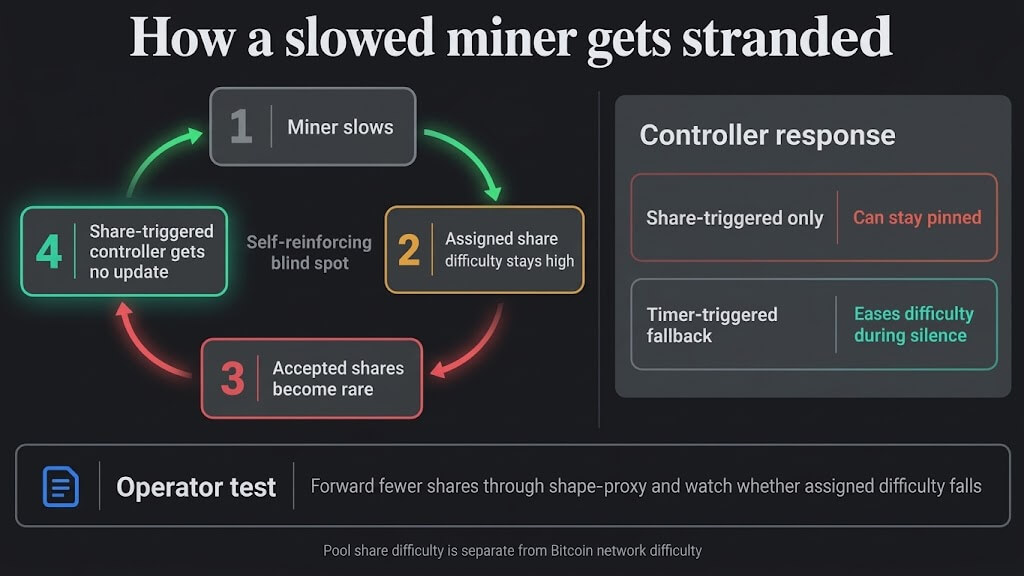
Price’s examination of these controllers outlines a trap that occurs when a miner experiences a rapid slowdown. Should the controller only recalculate when a new share arrives, the legacy, more difficult target makes the subsequent share much less probable. Without a new share to prompt an update, the controller can become locked into the incorrect difficulty, keeping the stream of shares sparse.
Sudden power curtailment is a practical reality in operations. CryptoSlate documented a significant drop in network hashrate during a January 2026 U.S. winter storm as operators scaled back energy usage, though that specific occurrence was not tied to any vardiff failure.
Operating with a high share difficulty does not automatically wipe out a miner’s anticipated credit over extended timeframes. As noted in documentation from Braiins’ pool, pools can assign greater accounting weight to a rare, high-difficulty proof. The financial risk emerges within the immediate realized window: pay-per-share miners earn nothing for that period if an accepted share fails to arrive, though any shares that do make it through remain eligible for payout. Meanwhile, under proportional payout methods, missing shares can elevate the reward share of other participants.
The current Stratum V2 reference implementation prevents permanent freezing by relying on a timer to recalculate and reduce difficulty during dry spells of shares. However, the analysis notes that recovery on long-running channels can still proceed slowly. Furthermore, this timer logic belongs specifically to the reference implementation rather than every individual deployment allowed under the Stratum V2 protocol.
Both Optech and the analysis point to ckpool as a real-world deployment example that uses share-triggered updates. Available sources have not yet measured how widespread this behavior is or whether it has generated tangible, real-world financial losses.
Operators now have the capability to test this phenomenon firsthand. The MARA Foundation open-source shape-proxy acknowledges local shares while passing along a regulated portion upstream. By utilizing step, ramp, and stall profiles, operators can simulate an apparent drop in performance for the pool without altering the physical output of the miner itself.
A decline in the assigned difficulty demonstrates that a tested controller possesses a functioning recovery mechanism. Conversely, a target that remains unchanged indicates sluggish or missing recovery under that specific profile and observation window, though outcomes can still be influenced by timer intervals, channel age, and the random arrival of shares.
Frequently Asked Questions
What causes a Bitcoin mining vardiff controller to get stuck?
A trap can occur when a miner sharply reduces its speed and the controller only recalculates the difficulty upon receiving a share. Because the older, harder assignment makes the next share less likely to appear, the lack of a fresh share prevents an update, leaving the controller stuck at the wrong difficulty and keeping the share stream sparse.
Does a high share difficulty completely erase a miner’s earnings?
Not necessarily over the long term, as pools can assign higher accounting weight to rare, high-difficulty proofs. However, risk arises in the immediate realized window—pay-per-share miners receive no payout for an interval if no accepted shares arrive.
How can operators test this behavior?
Operators can use tools like the MARA Foundation’s open-source shape-proxy, which acknowledges local shares while forwarding a controlled fraction upstream. This allows operators to test step, ramp, and stall profiles to see how a pool reacts to an apparent decline without altering physical miner output.

