
Bitcoin mining derivatives provider Luxor reported a 6–13% annualized Bitcoin financing spread in its September lookback, published Oct. 9. According to the firm, lenders and Bitcoin treasury companies acquired prepaid mining power and combined it with a price hedge, whereas miners utilized the reverse transaction to secure financing.
This yield stems from the discount a miner accepts in exchange for receiving upfront capital. While the hedge can lock in gross BTC receipts provided that mining delivery and settlement proceed smoothly, the investor’s capital remains vulnerable to failures anywhere along the repayment chain. Luxor’s reported September figure does not guarantee an executed return after accounting for costs, nor does it represent a quote available today.
Where the Bitcoin return comes from
Mining power, or hashrate, generates revenue at a metric known as hashprice. Luxor’s contracts define this rate in Bitcoin or dollars per unit of computing power per day. Purchasing future mining power exposes the buyer to the income generated by that power throughout the duration of the contract.
In a deliverable forward, the buyer covers the complete purchase price upfront. The seller is required to deliver hashrate to Luxor’s Bitcoin Mining Pool, with the buyer’s daily BTC settlement tethered to the hashprice index and the contracted volume of mining power.
This prepayment provides financing for the miner. Luxor notes that deliverable forwards typically trade at a discount compared to similar non-deliverable forwards to compensate the buyer for credit risk and the expense of locking up capital. This lower prepaid purchase price serves as the foundation for the lender’s prospective profit.
Absent a hedge, the buyer’s returns would fluctuate alongside the mining-revenue rate. Adding a paired trade—specifically the sale of a non-deliverable forward (NDF)—settles in cash rather than demanding physical delivery of mining power.
For the NDF seller, daily settlement is calculated as the agreed hashprice minus that day’s index rate, multiplied by the contracted hashrate. When the index falls below the agreed price, the seller collects the difference; when it rises above, the seller must pay the difference.
Should both legs share the same BTC denomination, hashrate quantity, settlement dates, and index methodology, their price exposures neutralize one another. Fully delivered mining receipts at the daily index rate, combined with the NDF settlement, equal receipts generated at the fixed NDF rate. Ultimate profitability depends on the extent to which these receipts outstrip the prepaid purchase price and other associated expenses.
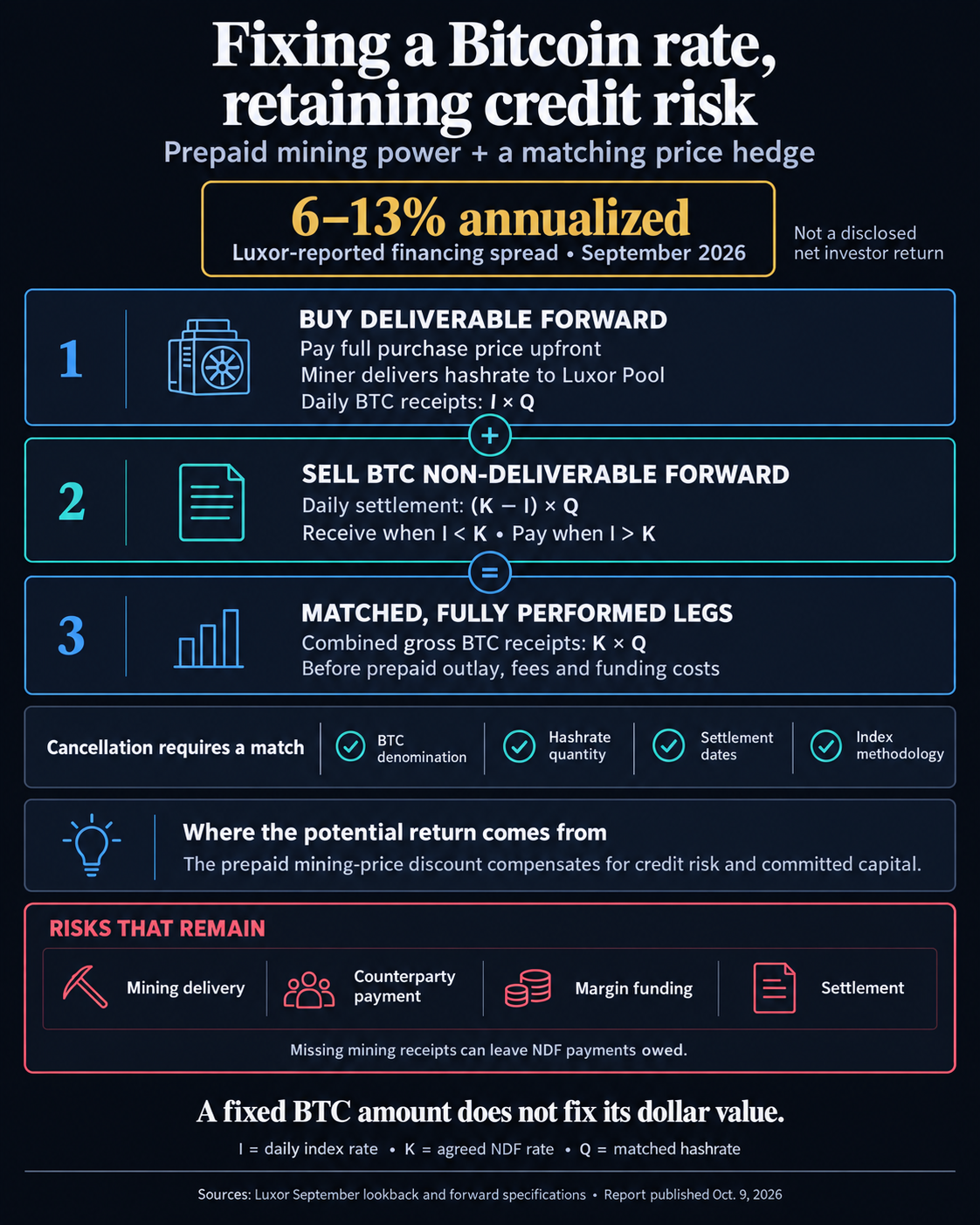
Precision in these matching conditions is critical. A hedge encompassing mismatched quantities or dates leaves a portion of the mining revenue exposed. Furthermore, substituting a dollar-denominated contract for a BTC-denominated one fails to preserve the identical Bitcoin payoff.
Similarly, a BTC-denominated hedge leaves the dollar value of Bitcoin receipts vulnerable to shifts in the BTC/USD exchange rate.
Luxor’s product documentation details monthly contracts stretching up to 18 months alongside custom durations. While this represents the general product scope, the September financing review does not specify which tenors generated the 6–13% return, nor does it disclose the annualization formula utilized.
Additionally, annualized pricing does not imply that an investor will realize that exact percentage over a shorter contract timeframe. The actual duration, repayment schedule, fees, and capital committed across both legs dictate the true return on invested funds.
Delivery failure can leave the hedge running
The neutralization of risk functions because the buyer collects the mining revenue against which the NDF settles. If the pledged mining power is not delivered and the deficit goes uncured, the revenue leg may fall short while obligations under the hedge remain active.
When the settlement hashprice exceeds the fixed NDF rate, the seller owes the difference, operating under the assumption that elevated mining receipts will offset the cost. If those expected receipts fail to materialize, the price hedge may demand payment without any incoming revenue to balance it.
A clear distinction also exists between the miner supplying the output and the investor’s contractual counterparty. Luxor’s order-book documentation designates Luxor as the counterparty to both buyers and sellers. Although the platform lists bids and asks and its derivatives team reaches out to parties to confirm trades, the order book itself does not function as an automated execution system.
For an investor, this means Luxor’s own operational reliability forms part of the repayment chain alongside the mining business itself.
Luxor’s upfront payment protocol mandates credit profiling for sellers before funds are disbursed. These prerequisites encompass mining-site and power documentation, insurance coverage, pool performance metrics, financial statements, and ongoing obligations. Its margin framework also specifies documentation for performance bonds or guarantors among supplemental checks.
While credit assessments mitigate uncertainty regarding a seller’s execution capabilities, recovering funds after a failure relies on enforceable claims. Publicly stated requirements do not outline a comprehensive repayment priority scheme or identify specific assets an investor can pursue following a default.
For eligible investors, collateral custody and exit options remain integral components of overall credit exposure. Although the order book permits the cancellation of open orders, this functionality does not apply to exiting an already confirmed forward contract.
Margin changes the capital calculation
Collateral requirements dictate how much extra capital might be necessary to maintain the hedge. Luxor’s margin guidelines mandate BTC collateral for BTC-based contracts and demand variation margin whenever the lower of realized and unrealized margin balances drops below maintenance thresholds. Credit-approved deliverable sellers may negotiate custom procedures tied to realized balances.
The policy outlines initial margin as a safeguard against potential exposure during the timeframe required to close out and replace a defaulted position.
Publicly available schedules display some inconsistencies: the NDF page cites an 18% BTC initial margin, the deliverable forward (DF) page lists an 18% seller hashprice margin alongside potential delivery margin, whereas the overarching policy states a 17.5% BTC initial margin and a 14% maintenance requirement on non-offset future daily notionals. The documentation does not explain these discrepancies.
The guidelines point to Nov. 14, 2025, as the date of their most recent initial margin assessment. Because qualified BTC deliverable sellers can secure discretionary initial terms following supplemental credit reviews, neither product page establishes a universal standard for the paired trade.
Buyers utilizing prepaid DFs are exempt from that specific leg’s initial margin schedule because they have already paid in full. However, this exemption does not imply that their NDF leg operates entirely free of collateral.
This capital allocation is pivotal when comparing the reported yield against an investor’s actual net return. Transaction fees, execution prices, and supplemental funds deployed to support the hedge can influence final earnings relative to the capital put at risk.
A case study involving Steelhead Capital Management illustrates this pairing in practice: Steelhead purchased physical hashrate upfront, integrated an NDF to lock in the hashprice, and relied on Luxor Pool for delivery, reward distribution, and settlement.
Luxor emphasizes that daily repayments serve to diminish exposure throughout the contract lifecycle. This mechanism facilitates the progressive return of capital, though any outstanding balance remains subject to ongoing performance risks.
Participation is also restricted. Luxor’s resource pages state that participants must qualify as Eligible Contract Participants. Examples include entities controlling over $10 million in assets and organizations with a net worth of at least $1 million engaging in commercial risk hedging. Consequently, this structure is not accessible to everyday retail Bitcoin holders.
FAQs
- What is the reported annualized Bitcoin yield from Luxor? Luxor reported a 6–13% annualized Bitcoin financing spread in its September lookback published on Oct. 9.
- How do lenders and miners generate this return? Lenders buy prepaid mining power paired with a price hedge, while miners use the reverse trade to secure upfront financing, earning a yield from the discount accepted by the miner.
- Is this investment strategy open to everyone? No, participation is restricted to Eligible Contract Participants, such as entities with over $10 million in assets or a net worth of at least $1 million hedging commercial risk.

