
While the overall concentration among the top three nations remained relatively steady, the estimated U.S. share of Bitcoin mining decreased as Russia’s footprint expanded.
According to country estimates released on Oct. 5 by Hashrate Index, the U.S. fell to roughly 335 EH/s from the previous edition’s 345 EH/s, whereas Russia climbed from 162 to 170 EH/s.
Together, the United States, Russia, and China continue to represent roughly 66% of the estimated network. Even with the total global hashrate estimate remaining nearly flat, their combined share dropped by approximately 0.8%.
This represents a minor adjustment in geographic distribution, though a more distinct shift has occurred in the balance between the two primary mining jurisdictions.
Luxor Technology’s mining data platform, Hashrate Index, designates the report as its fourth-quarter update, but the metrics reflect observations from the prior third quarter. Its July 16 comparison edition outlined June estimates.
The October publication functions neither as a finalized fourth-quarter outcome nor as a real-time census tracking active machinery as of Oct. 6.
A smaller US share leaves the same three leaders
The comparative analysis distinguishes absolute mining operations from network share. The estimated U.S. hashrate dropped as its portion decreased from 36.7% to 35.6%, while Russia secured increases in both estimated hashrate and network share, moving from 17.2% to 18.1%. Meanwhile, China’s estimate fell from approximately 115 to 110 EH/s.
| Location or metric | July edition | October edition |
|---|---|---|
| United States | About 345 EH/s; 36.7% | About 335 EH/s; 35.6% |
| Russia | About 162 EH/s; 17.2% | About 170 EH/s; 18.1% |
| China | About 115 EH/s; 12.2% | About 110 EH/s; 11.7% |
| Global network | About 940 EH/s | About 941 EH/s |
The network total is calculated as a 30-day simple moving average of hashrate, which measures the computational output dedicated to mining.
The provider’s methodology summary outlines a weighted mix of mining pool data, ASIC trading activity, and firmware usage patterns.
A separate mining-map methodology from Cambridge cautions that pool samples may lack proper representation and that the use of proxies or VPNs can skew inferred locations.
The October comparison from Hashrate Index places the combined share of the top three countries at 65.4%, down from 66.2%. Performing calculations using the rounded EH/s inputs yields roughly that same 0.8% drop. Consequently, the U.S. holds a reduced share while Russia’s share grows, leaving the same three nations in dominant positions.
The country shares published in July sum to 66.1%, whereas the rounded EH/s figures yield the provider’s stated 66.2% aggregate after rounding. These variances are separate from sampling or estimation discrepancies, and the comparison lacks any confidence range to establish statistical significance.
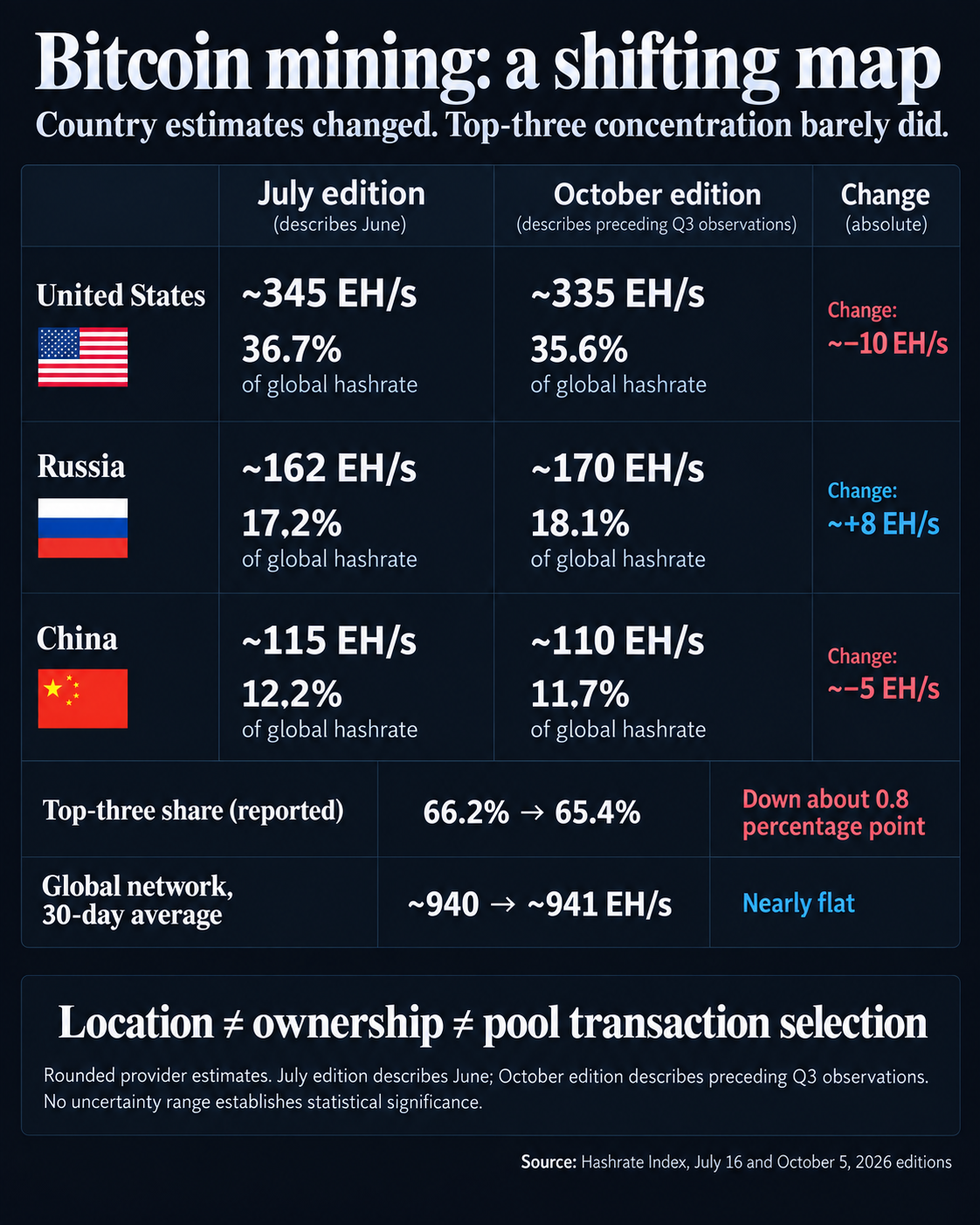
A reduced estimated U.S. share lowers the proportion assigned to that region, whereas an elevated Russian share raises its attributed percentage. While these shifts alter geographic exposure, they do not prove that the network has gained a broader base of independent mining capacity.
Hardware shutting down in one nation while other units activate elsewhere can alter the overall distribution without physical equipment being relocated between those places. Country totals do not demonstrate any direct transfer of assets from the U.S. to Russia.
Location leaves ownership and operating status unresolved
A nation’s mining share merely indicates the estimated geographic site of computing operations, whereas beneficial ownership identifies the actual owner of the hardware.
Pool control, by contrast, determines who coordinates mining activities and picks the transactions included in blocks. Treating these concepts as interchangeable would mistakenly turn a location metric into an assertion about decision-making authority.
The Bitcoin developer guide’s overview of pooled mining draws a line between the miners contributing hashing power and the pool operator that manages coordination and reward distribution. Under legacy Stratum protocols, participating miners obtain the data required to build block headers without gaining the ability to inspect or append transactions.
Because of this structure, transaction selection operates independently of the physical location of the hardware. Distributing equipment across a wider array of countries does not guarantee that a greater number of independent entities are determining block contents.
Likewise, a pool managing network operations is not necessarily the beneficial owner of every piece of equipment contributing power to it.
While Stratum V2 transaction-selection frameworks give miners the option to choose their own transaction sets, this capability does not indicate how widely it is utilized today.
Conducting a comprehensive evaluation would require data on asset ownership alongside real-time evidence regarding pool participation and block-template creation. Quarterly country-level data demonstrates neither enhanced ownership diversity nor steady pool concentration.
Geographic data also fails to explain operational shifts at individual sites. Luxor attributes certain regional mining reductions to a transition toward artificial intelligence and high-performance computing (HPC). Corporate disclosures confirm that this conversion trend is actively taking place.
In an operational update on Aug. 10, Keel Infrastructure announced it had finished decommissioning all U.S. Bitcoin mining activities to clear the way for HPC infrastructure development.
Similarly, Core Scientific outlined in its July 28 financial results an ongoing effort to transition its remaining mining facilities into high-density colocation services as conditions permit. This differs operationally from a complete exit from the mining sector.
These instances validate the specific maneuvers undertaken by individual firms. Reports exploring miners’ AI commitments had already addressed these execution questions prior to the release of this country comparison.
Equipment that has been temporarily idled can resume operations if the underlying catalysts for curtailment improve. Conversely, sites undergoing reconstruction or permanent reassignment to alternative workloads face a different recovery trajectory. Looking solely at a hashrate drop fails to explain what occurred or how long-lasting the impact will be.
In discussing a decline in Ethiopia, Luxor also points to local power restrictions. Such explanations require independent proof: regional changes alone cannot quantify the impact of power rationing, seasonal shifts, or regulatory policies. Geographic estimates and their proposed drivers remain distinct claims.
The network-wide estimate remained virtually unchanged, moving from roughly 940 to 941 EH/s. This overall stability can persist alongside lower activity in the U.S. because gains in other regions compensate for the losses, offering little insight into whether American miners have restored their operating capacity or improved their financial margins.
The most informative upcoming evidence will be specific to the mining risks under evaluation: consecutive country reports to measure persistence, corporate disclosures that differentiate real facility conversions from temporary shutdowns, and detailed ownership and pool metrics to assess control. A nearly flat network aggregate cannot address all three questions.
For the time being, geographic exposure has evolved within a mining ecosystem that remains highly concentrated. Confirming genuine decentralization progress requires concrete data regarding the ownership, coordination, and physical placement of mining capacity.
Frequently Asked Questions
Which three countries control the majority of Bitcoin mining?
The United States, Russia, and China account for approximately 66% of the estimated global Bitcoin network.
Did the U.S. share of Bitcoin mining increase or decrease?
The estimated U.S. mining footprint shrank, with its share dropping from 36.7% to 35.6% between editions.
Does a drop in a country’s hashrate mean its equipment was relocated?
No. Machines shutting down in one country and activating elsewhere can alter distribution without the physical equipment being moved between locations.

